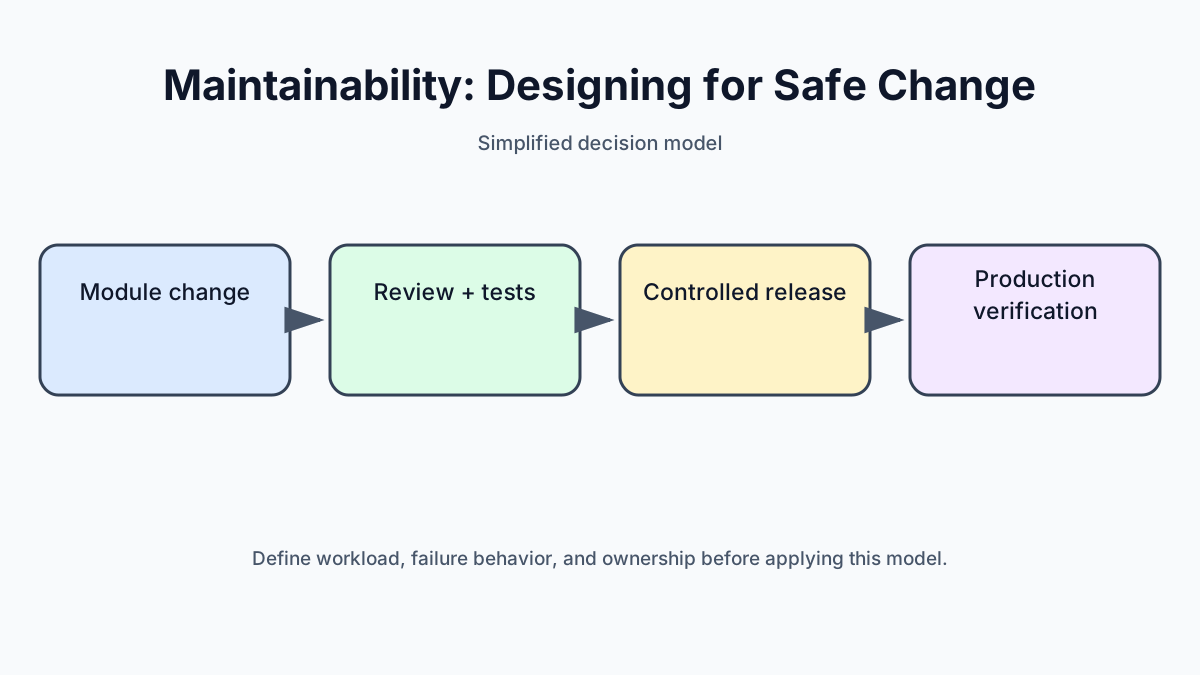
Maintainability is the ability to understand, modify, test, release, and operate a system at acceptable risk. It is not a synonym for short files, a particular framework, or a fully automated pipeline. A system is maintainable when a team can make a necessary change, predict the affected boundaries, verify the intended behavior, and recover if reality differs from the plan.
That definition includes code, data, delivery, documentation, and ownership. A beautifully organized module that cannot be deployed safely is not maintainable. Neither is a robust pipeline around a codebase that only one person understands.
Evaluate maintainability through a real change
Abstract scores are less revealing than following one representative change. Suppose a business system needs a new concession rule in fee calculation.
Ask:
- Where does the rule belong, and can the team find that location?
- Which interfaces, stored data, reports, and integrations depend on the result?
- Who can confirm the business interpretation?
- Which tests demonstrate the rule and its important boundaries?
- Can old and new application versions coexist during deployment?
- How will production behavior be verified?
- What is the recovery path if the rule is wrong?
This exercise exposes architectural coupling and organizational ambiguity that a static code metric misses.
Make boundaries match responsibilities
A module boundary is useful when it groups behavior and data around a coherent responsibility. The fee module should own calculation rules and expose an intentional interface. Callers should not reach into internal tables or duplicate formulas because doing so makes every future rule change wider and less predictable.
Good boundaries hide implementation details without hiding business meaning. A generic abstraction that removes all domain language can make changes harder to reason about. Name concepts directly, keep invariants near the data they protect, and avoid adding indirection until it solves a demonstrated source of change friction.
Dependency direction matters. Core business rules should not require knowledge of an HTTP controller, queue client, or vendor SDK. Adapters can translate at the edge. This lets tests exercise the rule without recreating the entire runtime and reduces the blast radius of infrastructure changes.
Boundaries are not necessarily separate services. A well-structured monolith can provide strong ownership and isolation with simpler transactions and operations. Splitting modules across the network adds deployment, compatibility, observability, and failure concerns. Distribute only when those tradeoffs support a real need.
Keep the change surface visible
Small, focused changes are easier to review because intent and risk remain legible. Avoid mixing a business rule, broad refactoring, dependency upgrades, and formatting churn in one release unless they genuinely must move together.
This does not mean never refactor. Refactoring can reduce the cost of the intended change, but separate preparatory restructuring from behavior changes when practical. Reviewers can then validate that one step preserves behavior and the next changes it intentionally.
Code ownership should identify responsible people without creating a bottleneck around one gatekeeper. At least several team members should understand critical areas. Pairing, reviews, concise architecture notes, and operational exercises spread context better than documentation that is never tested against change.
Record decisions that would otherwise be rediscovered: why a boundary exists, which alternatives were rejected, and which constraint could justify revisiting it. Do not document every line. Document the context that is expensive to infer.
Test at the boundaries that carry risk
Tests support maintainability when failures explain what contract was broken. For the concession rule, unit tests can cover calculation cases and boundary values. Integration tests can verify persistence or ledger behavior. A small end-to-end test can prove that the user workflow connects those parts correctly.
More tests are not automatically safer. Tests coupled to internal implementation create editing work without protecting behavior. Slow, flaky suites teach teams to ignore failures. Prefer a portfolio:
- fast tests for business rules and invariants;
- contract or integration tests at database and service boundaries;
- focused end-to-end tests for critical journeys;
- migration and rollback checks for data changes;
- production checks that validate the deployed workflow.
Use realistic failure cases as well as happy paths. Timeouts, duplicate messages, stale versions, invalid configuration, and unavailable dependencies often reveal the assumptions that make a change unsafe.
Treat data changes as compatibility changes
Database migrations are part of the application protocol. During a rolling deployment, old and new code may run together. A migration that immediately renames or removes a column can break the old version before the rollout completes.
Use expand-and-contract where appropriate: add a compatible structure, deploy code that can operate during transition, migrate or backfill data with bounded load, switch reads or writes, and remove the old structure only after it is no longer used. The exact sequence depends on the database and change, but compatibility must be deliberate.
Large backfills need throttling, observability, restartability, and validation. A migration that is safe on an empty development database may create locks or resource pressure in production. Test against representative shape and volume without inventing confidence from a small fixture.
Configuration and feature flags need the same discipline. Define owners, defaults, expiry or removal plans, and behavior when configuration is missing. Long-lived flags create hidden execution paths that future maintainers must understand.
Design the release and recovery together
A release artifact should be reproducible and traceable to reviewed source. Promote the same artifact through environments rather than rebuilding it with unknown differences. Automate repeatable checks, but remember that automation consistently executes whatever it was told—even when the instruction is flawed.
Use staged exposure when risk warrants it. A canary, percentage rollout, tenant cohort, or region-by-region deployment can limit the initial blast radius. The choice depends on whether traffic and state can be isolated meaningfully.
Health checks should represent readiness for new work. Production verification should go further and exercise the changed journey. Containers running and HTTP endpoints responding do not prove that the concession posts correctly to the ledger.
Choose rollback or forward fix before release. Rollback is practical only when code, schema, and side effects remain backward compatible. If a migration or external action is irreversible, the recovery plan may require a corrective release and reconciliation rather than pretending an old artifact can undo the change.
The engineering release governance case study shows how technical controls and decision ownership can be considered as one delivery system rather than separate concerns.
Observe behavior, not deployment activity
Maintainable systems make it possible to connect a release to user and system outcomes. Logs need stable context; metrics need meaningful dimensions; traces should reveal important dependency paths. Avoid collecting data without a question it can answer.
For each release, define the expected signal and a small set of failure signals. Compare the relevant user journey, error pattern, and resource behavior before and after exposure. Ensure alerts lead to an owned action rather than creating undifferentiated noise.
Operational runbooks should be executable. Include how to identify the failure state, which safe actions are available, what evidence to preserve, and when to escalate. Test them during exercises or real incidents and update them from what responders learn.
Look for practical maintainability signals
No single metric captures maintainability, but recurring evidence includes:
- routine changes have an identifiable owner and bounded dependency surface;
- reviewers can explain the change and its recovery path;
- environments and artifacts are reproducible;
- important interfaces have focused, trustworthy tests;
- data and API evolution supports version overlap;
- production verification covers user behavior;
- incidents and releases do not depend on one person’s memory.
Conversely, frequent emergency coordination for ordinary changes, fear of touching a module, unknown configuration ownership, and migrations that cannot be rehearsed are direct signs of maintainability debt.
Technical leadership is often needed because these concerns cross team and system boundaries. Technical leadership advisory can help connect architecture, ownership, release controls, and improvement sequencing when no single code change is enough.
Maintainability is demonstrated through safe change. Keep responsibilities understandable, compatibility explicit, tests focused on risk, releases observable, and recovery credible. The goal is not to eliminate change risk; it is to make that risk visible and manageable by the team that owns the system.